
PracticeEducational
Your Labs Came Back Normal. Here Is What I Do Next.
The draw and the conversation are the parts you can see. Most of the work of reading a set of results happens in between.
The part nobody describes
Most people have had blood drawn and been told it looked fine. What almost nobody is told is what happened in between, and that part is most of the work.
There is a reason for that, and it is structural rather than personal. A laboratory reference range answers one question: whether a result falls within the range established for that test. Reading an entire panel against your symptoms, history, previous results, medications, and goals asks a different set of questions, and it takes a kind of time that a short visit was never designed to hold.
So here is what happens to a set of results between the draw and the conversation.
After the draw
The sample goes to the lab, and the numbers come back to me first.
I read the panel one line at a time, against what is optimal for you.
I read it a second time as one picture, with your history and your last draw beside it.
I decide what changes now, what changes and gets rechecked, and what we watch.
We go through all of it together, and you come away with your own numbers and the reasoning behind them.
Steps two through four. This is the part you cannot see, and it is most of the work.
Some of it happens before the draw
A number means something different depending on the morning that produced it, so a few things have to be known before the draw rather than after it.
Fasting and medication timing both move results. If you take thyroid medication, the hours between your dose and the draw change what I see, which is why we time it deliberately. Supplements can matter in the same way. Biotin, which is in a great many hair and nail formulas, can interfere with the assay itself, so a thyroid result drawn on it may not be saying what it appears to say. Where you are in your cycle changes what a hormone level means, and so does whether you have been through menopause — the same estradiol result reads differently depending on that one fact.
Then there is what has changed since the last time: a new medication, an illness, a stretch of poor sleep, a diet that shifted, a supplement somebody recommended. All of it is the context the numbers get read against.
I read it one line at a time, and then all of it at once
When the results come back, I go through them twice, and the two passes ask different questions.
The first is line by line. Each marker gets read against the laboratory range, but also against what I consider optimal in the context of your symptoms, history, medications, and goals. That distinction is large enough that I have written about it on its own, and it is the reason a result can be reported as normal and still be worth my attention.
The second pass is the longer one. I stop reading the panel as a list and start reading it as a picture: what do these numbers say together, with this person's history sitting beside them.
| The pass | What I am asking | What I am looking for |
|---|---|---|
| One line at a time | Is this marker where I want it for this person, on this morning? | Values outside the optimal range, values that have moved since last time, and anything that needs attention today. |
| All of it at once | What do these results say together, and which of them is upstream of the others? | Several markers leaning the same direction, one result that explains another, and the pattern that no single line can show. |
Fatigue is the clearest illustration of why the second pass exists. It is a thyroid symptom, an iron symptom, a B12 symptom, a blood sugar symptom, a sleep symptom and a stress symptom, and sorting out which of those may be contributing means looking at them together, alongside your history and symptoms. Sometimes the answer is that it is three of them at once, each one small enough on its own to look unremarkable.
A panel read as a list gives you six answers. Read as a picture, it usually gives you one.
One result is a dot. Two results are a direction.
The most useful thing in a set of results is often not a number at all. It is the distance between this number and the last one.
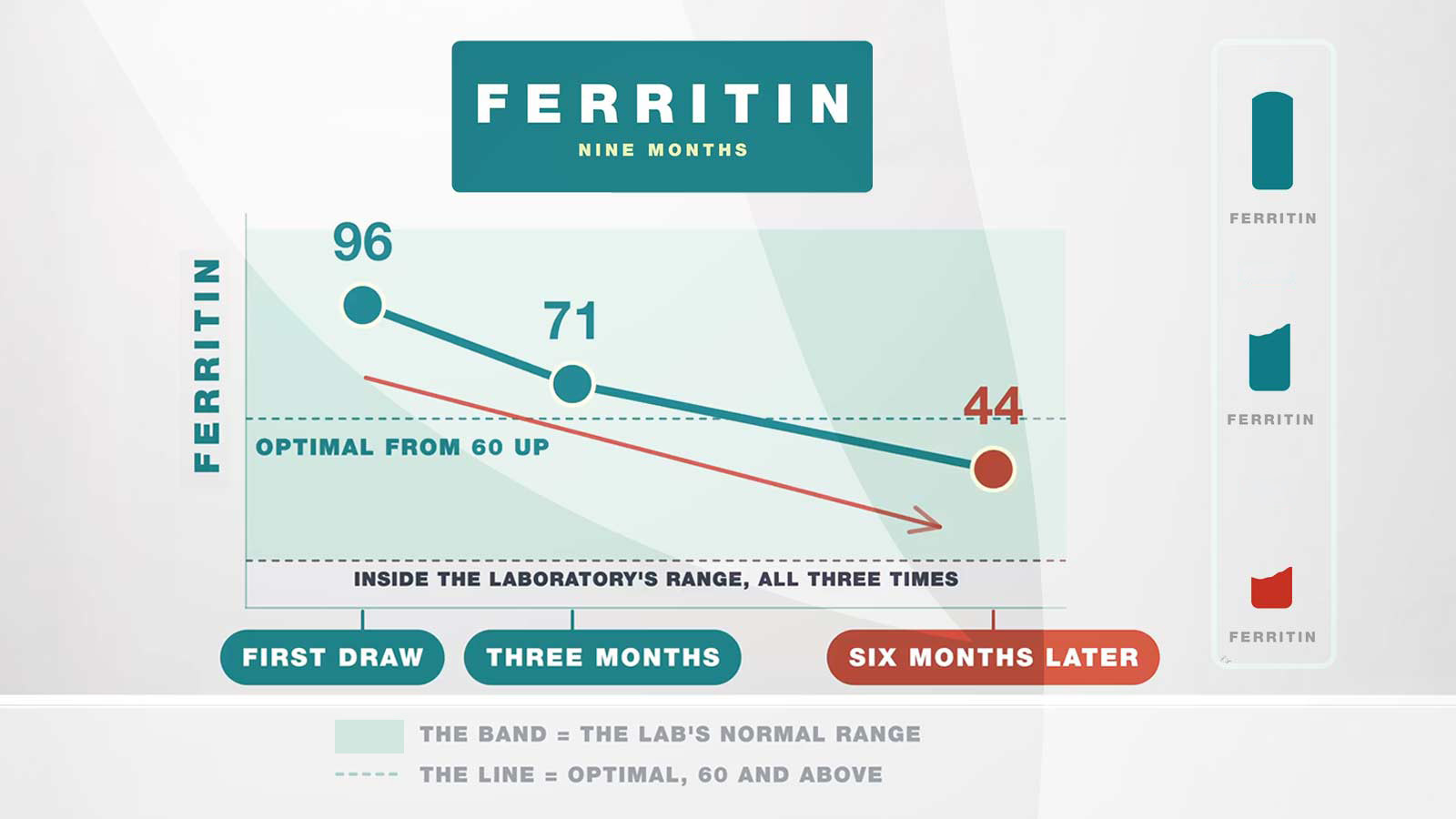
Here is the pattern I am describing. A patient comes to me tired. Her ferritin, which is the form iron is stored in, reads 96 on her first draw with me, comfortably where I want it. Three months later it is 71, and six months after that it is 44. Every one of those results was reported as normal, and by the laboratory's range every one of them was. Read only against that range, there was never a morning when the result was flagged.
Three draws, all reported normal
The direction was visible at the second draw — six months before the value crossed the threshold I use for optimal.
Read together, the direction is the finding, and a direction is the one thing a single draw cannot show you. By the third result we were not discovering a low ferritin. We were confirming something we had watched arrive, which meant the conversation was about why it was falling rather than about what the number was.
This is why your previous results sit open beside your new ones every time, and why a first panel is a starting point while the second one is where the reading gets sharper. It is also why I would rather recheck a marker than remember it.
Three findings, three different clocks
By the time I have been through a panel twice, what I have is a set of decisions rather than a set of numbers. They rarely share a timeline.
What happens to each finding
Acted on this week
Something that needs treating now.
A level low enough to help explain how you feel, or a finding that warrants intervention now. This one turns into a change you will hear about within days rather than at your next visit.
Something that changes, and then gets rechecked.
We change one thing, and the recheck is booked for the point where the change will have had time to show up in your blood.
Something I want to see again before I act.
In range, and moving in a way worth a second look. The marker goes on the list for the next draw with a reason attached, and nothing changes today.
Watched across the year
The third one matters most to explain — from the outside it can look like nothing happened. Watching a marker on purpose is a decision, and it comes with a date.
That bottom category is the one I try hardest to describe out loud, because a plan that includes waiting is easy to mistake for no plan at all.
The recheck is chosen by the biology, not by the calendar
When something does change — a dose, a nutrient, an approach to sleep or to food — the change arrives with a date to look again, and that date is set by how long the body takes to answer.
Iron stores are the clearest case. I generally give them about three months before rechecking. A thyroid adjustment often needs around six to eight weeks to settle before the next panel means much. A question asked too early gets an answer that reflects the morning rather than the change.
Which means the months between two draws are where the plan is actually being tested. The draw at the end is how we find out what happened — and if what we tried did not work, that is a finding too, and a faster one than waiting another year to ask again.
What the conversation is for
The reading has to arrive somewhere, and where it arrives is a conversation. Going through your results with you is the part that makes the rest of it usable, rather than the formality at the end of the process.
What you come away with
Your numbers, and which way they are moving
The value, what it was last time, and whether that direction is one we want.
What we are watching, and why
The markers that did not change anything today, said out loud rather than left off the summary.
What would change the plan
The result, or the symptom, that would make me do something different — so you know it when you see it.
In language you can repeat to someone else. That is the test I use for whether I have explained it.
I teach as I go for a practical reason as much as a principled one. Explaining my reasoning to the person it is about is how I find out whether the reasoning holds, and a patient who understands her own results is better equipped to notice when something changes between visits. The Meliora Method is built on that — five systems, read together and explained to you, because you are the one living in the body.
If your own results have been called normal while you continue to feel unwell, that is worth looking at properly, whenever you are ready.
The case described here is a composite, and the laboratory values are illustrative. Dr. Rowena Chua is the founder of Meliora Integrative Medicine in Evanston, IL and is triple board-certified in Neurology, Integrative Medicine, and Obesity Medicine. A longtime Evanston physician, she specializes in hormonal, metabolic, and neurological health.
Educational only. This article explains physiology; it is not medical advice, a diagnosis, or a treatment plan, and it cannot account for your own history, medications or results. For guidance specific to you, please speak with your physician.
Semper ad Meliora.
Always toward the pursuit of better.
Work with Meliora
Wondering what this looks like for you?
If something here resonated, we'd be glad to help you look at your own picture — your labs, your history, the whole system. That's the heart of how we practice.
Start hereIn Evanston, Illinois — and by video in all 50 states and DC.
Learn it yourself
The Meliora Academy
Dr. Chua teaching the Method in six modules, including Module 04 — Reading Your Own Labs, on optimal versus normal, and the panels to ask for. No appointment, no geography. It is in production now.
Join the waitlistMore from Meliora

Clinical
Your Weight Hasn't Changed in Years. Here Is What a DEXA Scan Can Show.
A body can rearrange itself a great deal underneath a weight that stays the same. A DEXA scan shows the three things a scale adds together: fat, muscle and bone.

Practice
Functional Medicine or Integrative Medicine? What to Ask Before You Choose a Doctor
A man came to see me because his wife made the appointment. She had found three practices while looking for someone who would take a proper look at him. One called itself functional medicine. One called itself integrative medicine. The third said holistic.

Clinical
You Can Take the Supplement and Still Not Absorb It
A woman came to see me carrying a bag of supplements and six months of taking them. Her iron was low, her B12 was low, her vitamin D was low, and her folate was low. Six months on, the numbers had barely moved.
Subscribe
Get future essays in your inbox.
Clinical perspectives from Dr. Chua and the Meliora team. No spam, no urgency, no nonsense.
Subscribe