
ClinicalEducational
Before a Sugar Detox, Know Your Fasting Insulin.
Cutting sugar for a few weeks can help you feel better. How well your body handles sugar all year is a separate question, and it has an answer you can often measure before blood sugar itself changes.
She did a sugar detox every January, and she was good at it. For three weeks she set aside sweets, bread and wine, and by the end of the second week she always felt better: steadier in the afternoon, sleeping more deeply, a little lighter. By March the old pattern had usually returned, along with the afternoon slump and the cravings, and she had started to wonder whether the problem was her willpower.
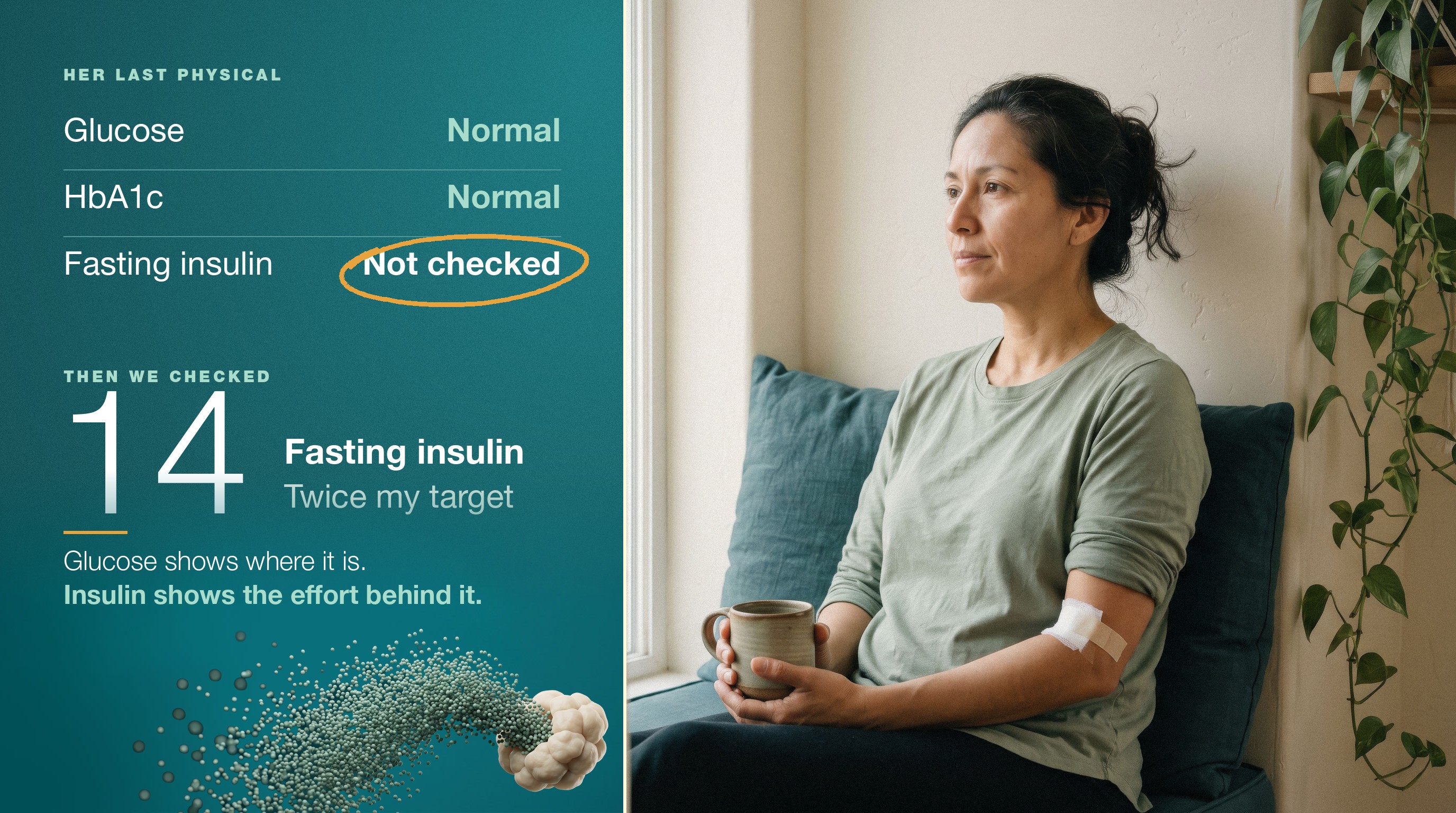
She came to see me at forty-four. Her annual physical the year before had been reassuring. Her fasting glucose was 94 and her HbA1c was 5.5, both inside the normal range, and she had been told her blood sugar was fine. Fasting insulin had not been part of that panel. When we checked it, it was 14.
Figure 1 — One panel, read two ways
Fasting glucose: 94
Reported as normal. Toward the top of the range, above the 75 to 90 I aim for.
HbA1c: 5.5
Reported as normal, and within the 5.6 or below I aim for.
Fasting insulin: 14
Not on her earlier panel. Twice the level I aim for.
Two of the three looked reassuring. The third showed how hard her body was working to keep them that way.
That number showed us something her other results had not yet shown. Her body was keeping her blood sugar normal, and it was working considerably harder than it should have to do it.
What a sugar detox does well
Cutting back on added sugar is a good instinct, and people feel better for real reasons, particularly when sweets and processed foods give way to more balanced meals. Many notice steadier energy, fewer cravings and better sleep, and for some a detox is the first time they see how much their eating was shaping their day. Those benefits are real, and they still do not tell us how well the body is responding to insulin.
The question a detox leaves open is how your body handles sugar for the rest of the year. The word suggests something that has built up and needs to be cleared out. What actually changes over time is how well your cells respond to insulin, and that changes slowly, in both directions, over months and years. It is also something we can measure.
How insulin keeps blood sugar normal
After you eat, glucose from your food enters your bloodstream, and your pancreas releases insulin to move it into your muscles, liver and fat cells, where it can be used or stored. In a body that responds to insulin well, a modest amount does the job.
When cells become less responsive, which is what insulin resistance means, the pancreas compensates by releasing more. More insulin moves the same amount of glucose, so blood sugar stays normal. This compensation can hold for years, and during those years fasting glucose and HbA1c can look entirely reassuring while insulin climbs underneath them.
Blood sugar starts to rise when that compensation falls short: the pancreas cannot keep pace, and the liver adds more glucose of its own. That is usually when a glucose result first comes back flagged as prediabetes or diabetes, and by then the underlying change has often been developing for some time.
Figure 2 — The order things usually move
Often years earlier
Insulin rises.
Cells respond less, so the pancreas releases more. Glucose and HbA1c still read normal.
The numbers drift.
Fasting glucose and HbA1c creep toward the top of their ranges, each still called normal.
Blood sugar is flagged.
Compensation falls short, and a result crosses into prediabetes or diabetes.
When it is usually found
In many people, fasting insulin rises before glucose or HbA1c looks abnormal. It is the one most routine panels leave out.
Glucose and HbA1c show where blood sugar is. Fasting insulin shows how much effort it is taking to keep it there.
Why fasting insulin is often left off
Patients often ask why, if fasting insulin can move first, it is not part of a routine panel. The answer lies in how screening is designed. Guidelines screen for diabetes with fasting glucose and HbA1c, because those are the tests the diagnosis is defined by. Fasting insulin has no single agreed cutoff, and results vary somewhat between laboratories, so it has stayed outside the standard workup.
In my practice I use it as an early signal rather than a diagnosis. The target I use is a fasting insulin below 7, a practice target rather than a diagnostic cutoff, and I read it alongside fasting glucose, HbA1c, triglycerides and HDL, because together they describe one metabolism from several sides. I have written about the difference between optimal and normal ranges before, and blood sugar is where that difference often shows up earliest. A fasting glucose below 100 is considered normal, and in my practice I generally look for values around 75 to 90, with an HbA1c of 5.6 or below, always read alongside insulin and the other markers.
Figure 3 — Five markers, one metabolism
| Marker | What it shows | What I aim for |
|---|---|---|
| Fasting insulin | How hard the pancreas is working to keep blood sugar steady | Below 7 |
| Fasting glucose | Blood sugar this morning, after an overnight fast | 75 to 90 |
| HbA1c | Average blood sugar over the past two to three months | 5.6 or below |
| Triglycerides | Fat in the blood, which tends to rise along with insulin | 150 or below |
| HDL | The protective cholesterol, which tends to fall as insulin rises | 50 or above for women, 40 or above for men |
Read together, not one at a time. These are the targets I use in my practice, not diagnostic cutoffs. Each number is one view of the same metabolism, and the pattern across them says more than any single line.
A single fasting insulin is a starting point. Insulin moves with sleep, stress, a late meal and the morning of the draw itself, so like any marker it means more as a trend than as one result. In an earlier piece I wrote that one result is a dot and two results are a direction, and that is especially true here.
What insulin resistance can feel like
Insulin resistance often develops without obvious symptoms. Some people notice an energy dip in the mid-afternoon, hunger that returns soon after eating, a pull toward something sweet after meals, or weight that gathers around the middle even when the scale moves only a little. Each of these has many possible causes, and none of them can establish insulin resistance on its own, which is why measuring is useful.
Weight around the middle deserves its own mention. Visceral fat, the fat packed around the organs, and insulin resistance tend to rise together, and each makes the other harder to reverse. A DEXA scan estimates visceral fat as part of body composition, and when it is climbing I look at fasting insulin alongside it.
Insulin resistance also occurs in people at a healthy weight. I have seen patients whose weight held steady for years while their metabolic markers told a different story, which is one reason I look at body composition, muscle and lab markers together rather than the number on the scale alone.
What helps
The encouraging part of an early signal is that the body is still compensating, so there is time and room to change direction. That stays true even after a result has been flagged. In my practice, a number of patients with prediabetes have brought their glucose and HbA1c back into the normal range. We keep watching insulin after that, because a normal glucose is not the same as insulin resistance that has fully resolved.
We approach this through the Meliora Method, addressing nutrition, muscle health, hormonal balance, nutrient deficiencies and stress regulation together. For some patients, a GLP-1 medication is also part of the plan. The changes that make the greatest difference are the ones patients can sustain over time.
Figure 4 — Two kinds of change
A few weeks without sugar
Steadier energy, often within two weeks
Fewer cravings and better sleep
A clear sense of how eating was shaping the day
What helps over a year
Building and keeping muscle
A short walk after meals
Protein and fiber at each meal
Vitamin D, B12 and magnesium where they are low
Enough sleep, and a lighter stress load
Hormones, during the transition
The first is worth keeping as a pattern. The second is what shows up in the blood work.
Muscle. Muscle is one of the largest places glucose goes after a meal, so building and keeping muscle is one of the most direct ways to improve how the body handles sugar. It is one reason I ask about strength training as often as I ask about diet.
Movement after meals. A short walk after eating helps working muscles take up glucose and can soften the rise in blood sugar that follows a meal.
How meals are built. Protein and fiber at each meal slow how quickly glucose arrives, which is gentler on insulin than the same food eaten on its own. This is the part of a sugar detox worth keeping, as a pattern rather than a three-week event.
Nutrients. Low nutrient levels can cause fatigue and other symptoms that overlap with metabolic ones. I routinely check vitamin D and B12, and I look at magnesium through diet and symptoms. Vitamin D is associated with metabolic health, B12 supports the nerves and energy metabolism, and magnesium plays a role in how insulin signals to cells. When a level is low, correcting it is part of a complete plan, though it does not replace the changes above that improve insulin sensitivity.
Sleep and stress. Even a few nights of short sleep can measurably reduce insulin sensitivity, and stress hormones raise blood sugar by design. I wrote about this in my article on stress, and it is often part of why blood sugar is harder to manage during a difficult stretch of life.
Hormones. During perimenopause and menopause, changing estrogen tends to shift fat toward the abdomen. Together with aging and the gradual loss of muscle, that can make blood sugar harder to manage, which is one reason a pattern that held for years can change in the forties. When hormones are part of the picture, I consider them alongside nutrition, movement and sleep.
For some people, medication has a place as well, alongside these changes. I have written separately about GLP-1 medications and who they are for.
The woman at the start of this piece kept her January habit, and it became a smaller part of a larger plan. We focused on strength training twice a week, protein at breakfast, a walk after dinner and her sleep, which had been shorter than she realized. Six months later her fasting insulin was 8, and the afternoon slump that used to send her looking for something sweet had mostly faded. Her glucose and HbA1c barely moved, which is what we expected, because they had been within range all along.
Figure 5 — Six months, one marker (illustrative composite)
The marker that moved first was also the one that showed the change. Her glucose and HbA1c had been within range all along.
If you have had blood work recently, it can be worth checking whether fasting insulin was on it. At Meliora we include it in our lab panels and read it alongside the rest of your results, and when blood sugar is part of a broader weight question, our medical weight loss program starts in the same place. Whenever you are ready, I would be glad to help you look.
The patient example in this article is a composite based on patterns I commonly see in practice. Patient details, laboratory values and outcomes are illustrative. Dr. Rowena Chua is the founder of Meliora Integrative Medicine in Evanston, IL and is triple board-certified in Neurology, Integrative Medicine, and Obesity Medicine. A longtime Evanston physician, she specializes in hormonal, metabolic, and neurological health.
Educational only. This article explains physiology; it is not medical advice, a diagnosis, or a treatment plan, and it cannot account for your own history, medications or results. For guidance specific to you, please speak with your physician.
Semper ad Meliora.
Always toward the pursuit of better.
Work with Meliora
Wondering what this looks like for you?
If something here resonated, we'd be glad to help you look at your own picture — your labs, your history, the whole system. That's the heart of how we practice.
Start hereIn Evanston, Illinois — and by video in all 50 states and DC.
Learn it yourself
The Meliora Academy
Dr. Chua teaching the Method in six modules, including Module 04 — Reading Your Own Labs, on optimal versus normal, and the panels to ask for. No appointment, no geography. It is in production now.
Join the waitlistMore from Meliora

Clinical
Your Thyroid Antibodies Are Positive. Here Is What I Do Next.
Positive TPO antibodies with a normal TSH usually means Hashimoto’s, years before the thyroid slows. Here is how I use those years: the gut, the immune system, and what I watch over time.

Clinical
Is Hormone Therapy Safe? What Has Changed Since 2002.
Most of what women hear about hormone therapy still comes from one trial in 2002. The risks turned out to depend on when you start, which hormones you take and how they enter the body, and the FDA has begun revising the label.

Clinical
Your Weight Hasn't Changed in Years. Here Is What a DEXA Scan Can Show.
A body can rearrange itself a great deal underneath a weight that stays the same. A DEXA scan shows the three things a scale adds together: fat, muscle and bone.
Subscribe
Get future essays in your inbox.
Clinical perspectives from Dr. Chua and the Meliora team. No spam, no urgency, no nonsense.
Subscribe