
ClinicalEducational
Your Weight Hasn't Changed in Years. Here Is What a DEXA Scan Can Show.
A scale adds everything together into one number. A DEXA scan separates fat, muscle and bone, and shows which way each of them is moving.
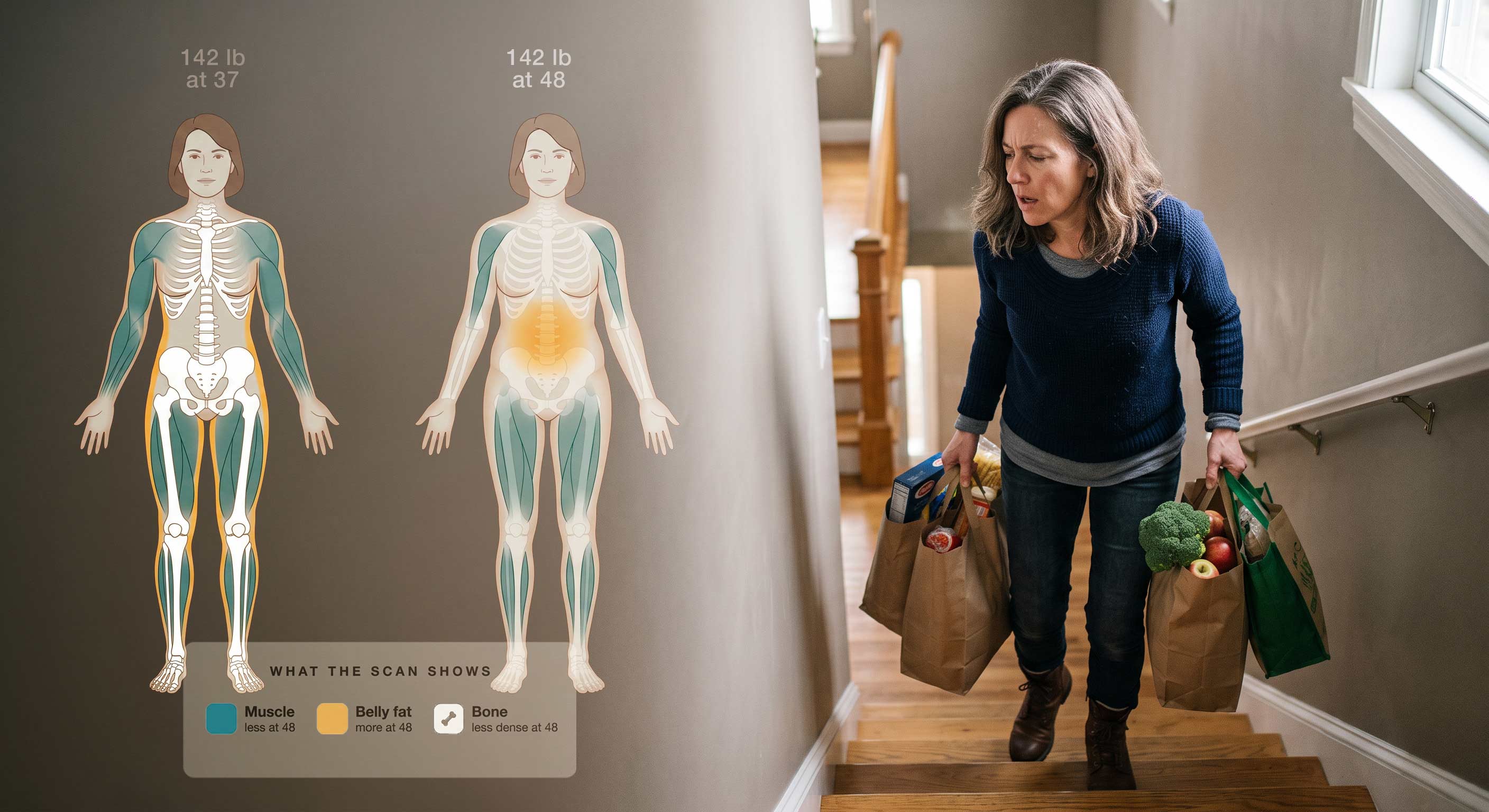
Her weight had been the same for eleven years, and she mentioned it the way people mention something they have worked hard for. She had every reason to be proud of it. She walked most days, she ate carefully, and the number on her bathroom scale had barely moved since her late thirties.
She came in at forty-eight because her clothes were fitting differently around her middle, and because carrying groceries up the stairs felt harder than she remembered. Both sounded to her like small things. Her scan showed what was underneath them. She had less muscle than I would want to see at her age, more fat stored deep inside her abdomen than she had any way of seeing, and bone density lower than I would like to find at the start of menopause.
All three had been changing for years, and her weight held perfectly still the whole time. A scale reports a single number, the sum of everything you are, and a body can rearrange itself a great deal underneath a sum that stays the same.
What the scan actually measures
DEXA stands for dual-energy X-ray absorptiometry. It uses two very low-dose X-ray beams, and because fat, lean tissue and bone each absorb those beams differently, the scan can tell the three apart and measure each one separately. It measures them region by region as well: arms, legs, trunk, and the left and right sides of the body.
That gives three readings a scale folds together: how much fat you carry and where it sits, how much lean mass you have, which is mostly muscle, and how dense your bones are. Each one tells a different part of the story, and each one changes on its own schedule.
I have written about what happens to muscle during rapid weight loss on GLP-1 medications, where the scale goes down and some of what it counts as progress is lean mass. The woman above is the quieter version of the same problem. Her weight never moved, so nothing in the usual checkup gave anyone a reason to look.
Figure 1 — One scan, three readings
Fat, and where it sits
Total fat, fat by region, and visceral fat, the fat packed around the organs.
Lean mass
Mostly muscle, measured by region, including whether one side carries less than the other.
Bone density
How dense the skeleton is, and a baseline to compare against as it changes.
A scale reports the sum of all three. Fat can rise while muscle and bone fall, and the total can stay exactly where it was.
The fat that matters most is the fat you cannot see
The fat under your skin, the kind you can pinch, is mostly storage. Visceral fat works differently. It sits deep inside the abdomen, packed around the liver, the intestines and the other organs, and it behaves more like an active tissue than a storage depot. It releases inflammatory signals and fatty acids that travel directly to the liver, and it is closely tied to insulin resistance, fatty liver and heart disease.
It is also invisible from the outside. Two people with the same waistline can carry very different amounts of it, and someone slim can carry more than you would guess. Of everything on a DEXA body-composition report, visceral fat is one of the numbers I watch most closely, because it can reveal metabolic risk that total weight alone does not.
For women, the menopause transition changes where the body stores fat, moving it away from the hips and thighs and toward the abdomen. That is part of why so many women in their forties notice their shape changing while their weight holds steady. Men tend to gather visceral fat more gradually with age. In both, the scan can show visceral fat accumulating even when routine blood work still looks reassuring. When I see it climbing, I read it alongside fasting insulin, HbA1c and the rest of the lab panel, because the scan and the labs describe the same metabolism from two sides.
Muscle is the part of you that ages quietly
Adults begin losing muscle gradually from around their thirties, and the pace picks up with each decade unless something works against it. Because the loss is slow, it rarely arrives as a symptom. It arrives as stairs that feel a little steeper, or a suitcase that seems heavier than it used to.
Muscle matters well beyond strength. It is a major site for glucose disposal after a meal, so losing muscle can make metabolic health harder to maintain. And later in life, muscle is much of what keeps you strong, mobile and steady on your feet, which matters even more once bone has begun to thin.
A DEXA scan measures lean mass directly and by region, so it shows whether muscle is holding or slipping, and whether one side has less than the other. It also shows whether the work someone is putting in, the training, the protein, a hormone plan, is actually building or protecting muscle.
Bone changes fastest in the years it is least often measured
Bone is living tissue, broken down and rebuilt throughout life. In women, estrogen helps keep those two processes in balance, so as estrogen falls, the balance tips toward breakdown. The fastest bone loss of a woman's adult life happens in the few years on either side of her final period. I have written about how early perimenopause can begin, and this is one of the reasons that matters: the change in bone starts during the transition, often before a woman thinks of herself as being in it.
Routine bone density screening, as the guidelines are currently written, begins for most women at sixty-five, and earlier for women with particular risk factors. Those guidelines are designed to identify people at increased fracture risk, but that means routine screening often comes after the years when bone loss is fastest. A body-composition scan in your forties or early fifties can also provide information about bone mineral density at a time when bone is beginning to change. It is not a substitute for a dedicated osteoporosis evaluation, but it can establish an earlier reference point and sometimes identify a reason to look more closely.
Men lose bone too, more slowly. Low testosterone, some long-term medications and heavy alcohol use can all speed that up, and for a man with any of those, bone density is worth knowing.
A whole-body scan gives a reliable overall picture of bone density and how it changes over time. When that picture raises a concern, the formal diagnosis of osteoporosis is made from dedicated measurements at the hip and spine, and I will tell you whether that next step makes sense for you.
One scan is a starting point. Two scans show a direction.
In my last article I wrote that one lab result is a dot and two results are a direction. The same is true of a scan, perhaps more so, because body composition moves slowly and the question that matters most is which way it is moving.
A first scan tells you where you are. A second, often a year later, tells you where you are going: whether fat is coming off or accumulating, whether muscle is being built or lost, whether bone is holding. During active weight loss or a focused muscle-building program, repeating body composition sooner can sometimes be useful. Bone changes more slowly and needs to be interpreted over an appropriate interval, with measurement precision in mind.
This is why I find an earlier body-composition baseline so useful. A baseline taken at forty-five is one of the most useful things you can have at fifty, because it turns a single reading into a comparison. Without a prior scan, much of the comparison comes from population reference data. With a baseline, you can also be measured against yourself.
What the scan itself is like
Patients often ask what to expect, and the answer is reassuring. You lie on a padded table, fully clothed, while a scanning arm passes slowly over you. It takes about ten minutes, with no injections and nothing to feel. The radiation dose is very low, less than you would receive on a cross-country flight, although it is still a scan we avoid during pregnancy. There is no need to fast. The only preparation is skipping lotion that morning and wearing clothes without metal.
The numbers are ready the same day. What gives them meaning is reading them together, with your history, your labs and what you are trying to change. A visceral fat reading means one thing in someone whose fasting insulin is climbing and something else in someone whose labs are clean. Lean mass means one thing in a runner and another in someone recovering from a long illness. Bone density informs decisions about hormones, supplements and training, and body composition shapes the metabolic side of a plan.
The woman at the start of this piece did not need a lower number on the scale. She needed to build muscle, reduce visceral fat and protect her bone through the years ahead, and she needed a way to see whether any of it was working. A year later her weight was almost exactly the same. Her second scan showed more muscle, less visceral fat, and bone that had held.
A DEXA scan is open to anyone, patient or not, at our office in Evanston. If you have been wondering what is happening underneath a number that has not moved in years, it is a good place to start, whenever you are ready.
The patient example in this article is a composite based on patterns I commonly see in practice; identifying details have been changed. Dr. Rowena Chua is the founder of Meliora Integrative Medicine in Evanston, IL and is triple board-certified in Neurology, Integrative Medicine, and Obesity Medicine. A longtime Evanston physician, she specializes in hormonal, metabolic, and neurological health.
Educational only. This article explains physiology; it is not medical advice, a diagnosis, or a treatment plan, and it cannot account for your own history, medications or results. For guidance specific to you, please speak with your physician.
Semper ad Meliora.
Always toward the pursuit of better.
Work with Meliora
Wondering what this looks like for you?
If something here resonated, we'd be glad to help you look at your own picture — your labs, your history, the whole system. That's the heart of how we practice.
Start hereIn Evanston, Illinois — and by video in all 50 states and DC.
Learn it yourself
The Meliora Academy
Dr. Chua teaching the Method in six modules — hormones, the nervous system, your own labs, nutrition and a 90-day reset. No appointment, no geography. It is in production now.
Join the waitlistMore from Meliora

Clinical
Your Thyroid Antibodies Are Positive. Here Is What I Do Next.
Positive TPO antibodies with a normal TSH usually means Hashimoto’s, years before the thyroid slows. Here is how I use those years: the gut, the immune system, and what I watch over time.

Clinical
Is Hormone Therapy Safe? What Has Changed Since 2002.
Most of what women hear about hormone therapy still comes from one trial in 2002. The risks turned out to depend on when you start, which hormones you take and how they enter the body, and the FDA has begun revising the label.
Practice
Your Labs Came Back Normal. Here Is What I Do Next.
Most people have had blood drawn and been told it looked fine. What almost nobody is told is what happened in between, and that part is most of the work.
Subscribe
Get future essays in your inbox.
Clinical perspectives from Dr. Chua and the Meliora team. No spam, no urgency, no nonsense.
Subscribe